Knabe’s Corner

Dispatches from the Supervisor

Special Olympics World Games Roundup

medals-2http://knabe.com/site/wp-content/uploads/2015/07/medals-2-150x150.jpg 150w, http://knabe.com/site/wp-content/uploads/2015/07/medals-2-246x246.jpg 246w, http://knabe.com/site/wp-content/uploads/2015/07/medals-2-120x120.jpg 120w, http://knabe.com/site/wp-content/uploads/2015/07/medals-2-210x210.jpg 210w, http://knabe.com/site/wp-content/uploads/2015/07/medals-2.jpg 340w" sizes="(max-width: 400px) 100vw, 400px" />

Finland and Kenya #ReachUpLA!

A video posted by Don Knabe (@donknabe) on

Industry ‘Meals on Wheels’ crew serves over 1,000 meals a month

Every Monday, 87-year-old Ken Kim drives to Queen of the Valley Hospital in West Covina to load up his car with meals for people in need. Depending on the week, he hits anywhere from 12 to 17 homes, providing nourishment for the elderly and sick in neighboring southland cities.

“It keeps me involved in the community,” said Kim, who has been associated with Industry’s Meals on Wheels program for 22 years. “I can cover my route in about three hours, and I’ve formed some great social connections with the other volunteers.”

Kim is among roughly 34 volunteers currently serving the cities of Bassett, City of Industry, Covina, Diamond Bar, Hacienda Heights, La Puente, Rowland Heights, Valinda, Walnut and West Covina. The Industry chapter of Meals on Wheels has been active since 1979, delivering well-balanced meals to people who have difficulty obtaining meals for themselves due to physical, mental, or financial limitations.

“Volunteers are the heart and soul of Meals on Wheels’ success,” said Supervisor Don Knabe. “I’m proud to support an organization that makes such a positive impact on residents and the community.”

The Queen of Valley Hospital sources the food, and drivers meet there to pick up meals for delivery Monday through Friday. Typically, volunteers commit to one day a week, driving the same route on their scheduled day. Together, the small but mighty crew serves approximately 88 recipients, which calculates to almost 1,300 meals a month.

“Many of our drivers are really dedicated to their routes and build a relationship with the people they serve,” said Joe Gardner, president of the Industry organization. “One recipient is 100 years old and really enjoys our visits – it can sometimes be the only human interaction she gets during a week.”

Gardner, who was inspired to become a driver after retiring as a sergeant of the Santa Monica Police Department, said there is a long waiting list of individuals who could benefit from Meals on Wheels. The challenge is to sign up more volunteers.

“The bigger our team, the more we can serve,” said Gardner.

Volunteers must be a licensed driver, have insurance, and of course sport a willingness to help.

“This is a great chance for retired individuals to get involved,” said Kim. “It keeps you moving and involved, which keeps you young.”

To learn more about Industry’s Meal on Wheels chapter visit www.mealsonwheels411.org.

2015 Special Olympics World Games

As you know, the Special Olympics World Games are coming to Los Angeles County. The Opening Ceremonies are set for Saturday, July 25 at the L.A. Memorial Coliseum. More than 7,000 athletes from 177 countries will be arriving in town this week, making the World Games the largest event we’ve hosted since the 1984 Olympics.

Below, you’ll find everything you need to know about the Special Olympics World Games. All of the athletic competitions are free to attend, so I hope you’ll find some time to come out to an event and support the athletes. Whether it’s beach volleyball or roller skating, I promise you will be inspired by every single athlete who is competing. Stay tuned to Facebook and Twitter for updates from the events.

Have a great week and I will see you at the World Games!

spectatorhttp://knabe.com/site/wp-content/uploads/2015/07/spectator-150x150.jpg 150w, http://knabe.com/site/wp-content/uploads/2015/07/spectator-246x244.jpg 246w, http://knabe.com/site/wp-content/uploads/2015/07/spectator-121x120.jpg 121w, http://knabe.com/site/wp-content/uploads/2015/07/spectator-210x209.jpg 210w, http://knabe.com/site/wp-content/uploads/2015/07/spectator.jpg 486w" sizes="(max-width: 300px) 100vw, 300px" />

the-gameshttp://knabe.com/site/wp-content/uploads/2015/07/the-games-150x150.jpg 150w, http://knabe.com/site/wp-content/uploads/2015/07/the-games-246x244.jpg 246w, http://knabe.com/site/wp-content/uploads/2015/07/the-games-121x120.jpg 121w, http://knabe.com/site/wp-content/uploads/2015/07/the-games-210x209.jpg 210w, http://knabe.com/site/wp-content/uploads/2015/07/the-games.jpg 486w" sizes="(max-width: 300px) 100vw, 300px" />

fan-in-the-standshttp://knabe.com/site/wp-content/uploads/2015/07/fan-in-the-stands-150x150.jpg 150w, http://knabe.com/site/wp-content/uploads/2015/07/fan-in-the-stands-246x244.jpg 246w, http://knabe.com/site/wp-content/uploads/2015/07/fan-in-the-stands-121x120.jpg 121w, http://knabe.com/site/wp-content/uploads/2015/07/fan-in-the-stands-210x209.jpg 210w, http://knabe.com/site/wp-content/uploads/2015/07/fan-in-the-stands.jpg 486w" sizes="(max-width: 300px) 100vw, 300px" />

opening-ceremonieshttp://knabe.com/site/wp-content/uploads/2015/07/opening-ceremonies-150x150.jpg 150w, http://knabe.com/site/wp-content/uploads/2015/07/opening-ceremonies-246x244.jpg 246w, http://knabe.com/site/wp-content/uploads/2015/07/opening-ceremonies-121x120.jpg 121w, http://knabe.com/site/wp-content/uploads/2015/07/opening-ceremonies-210x209.jpg 210w, http://knabe.com/site/wp-content/uploads/2015/07/opening-ceremonies.jpg 486w" sizes="(max-width: 300px) 100vw, 300px" />

Child sex trafficking survivor graduates high school and advocates for victims

Kyeisha has a message for childhood sex trafficking victims: your past does not define your future.

“I’ve been there, been manipulated, been abused,” said Kyeisha, herself a childhood sex trafficking victim in Los Angeles County when she was just 13 years old. “But I survived, and now I’m excited for my future.”

Kyeisha, now 18, has escaped her abusive relationships with the help of intervention from her probation officer, law enforcement, strong mentors and programs designed to remove children from the aggressors and pimps who prey on young kids.  In June, she graduated from high school, and this fall will begin general education work at El Camino College.

Kyeisha was also recently selected to be a part of the Annie E. Casey Juvenile Justice Strategy Group Youth Advisory Council, a group devoted to changing juvenile laws around trafficking, as well as educating government and communities about this heinous crime.

“When I was arrested, I was labeled a prostitute,” said Kyeisha. “I felt judged and hurt – but what I really needed at the time was help.”

Thankfully, at 15, Kyeisha was assigned to LA County Probation Officer Terrika Woolfolk, and together they identified a plan to keep her off the streets and place her on a path to success. The young teen voluntarily entered a treatment program in Iowa, received counseling, and got a healthy dose of ongoing encouragement from Woolfolk.

“I immediately noticed Kyeisha’s leadership capabilities and built on her strengths,” said Woolfolk. “She has such a good heart and I wanted to channel that positive energy to help her, and allow her to help others.”

Woolfolk notes many girls like Kyeisha lack a family support system, so they need individuals in their lives to be open, honest and encouraging – not label.

“We didn’t even realize childhood sex trafficking was happening right here in Los Angeles,” said Michelle Guymon, director of the child trafficking unit within probation for LA County. “I thought it was something that happened in other countries, not here.”

But in 2010, the trafficking issue entered Guymon’s radar. As the director of Camp Scudder, one of the local probation camps within L.A.County, Guymon began to make a link between the stories she was hearing from the girls around sexual abuse and trafficking.

“Girls didn’t even realize what was happening to them when they were arrested for prostitution,” said Guymon. “I saw we needed to change the conversation – these girls were not out on the streets by choice, they were victims.”

Now, with the help of advocates like Guymon and Woolfolk, the County is working to support the girls rather than incarcerate them.

For Kyeisha, the different approach has made all the difference.

“There are still days I feel judged about my past,” said Kyeisha. “But now I want to help victims, show them they are loved and put them on the path to education, building a resume, and finding a job.”

With her advisory work, Kyeisha will continue to tell her story and shape how this nation handles sex trafficking victims today and in the future.

“In all of my years of service, child sex trafficking has truly been one of the most horrific issues I’ve seen,” said LA County Supervisor Don Knabe. “With the help of survivors like Kyeisha, we can learn how to stop the cycle, protect our youth and help them find their own bright futures – we owe them that.”


Fourth of July reflections

This weekend is the Fourth of July-the day we spend surrounded by friends and family celebrating everything that we love about our country: freedom, liberty and democracy. But before you light the grill and watch the fireworks, I hope you will take some time to look back on the events of last week, from the streets of Charleston, to the steps of the Supreme Court, and their implications for the future of our nation.

The senseless and horrific violence at a place of worship shattered our sense of peace, but it did not break us. Instead it made us stronger and a sense of unity, not seen in over a decade, washed over us. At the funeral for one of the victims of the shooting, men and women, blacks and whites, reds and blues, joined together in prayer and song.  I was incredibly humbled by the faith, resiliency and strength shown by the victims’ families and the community. I hope their example of graceful spirit guides our country moving forward.

Meanwhile, in Washington D.C., the Supreme Court ruled in several cases with major implications locally. The Court ruled in favor of the legality of the Affordable Care Act. I’ve said it before and I’ll say it again: It doesn’t matter if you were for it or against it, the Affordable Care Act is here, and Los Angeles County has to move forward.  The Supreme Court also ruled in favor of same-sex marriage nationwide.  Friends and former staff members have waited a long time for this day.

However, the Supreme Court didn’t rule in favor of the rights of everyone-in an absolutely stunning decision, the court struck down a local ordinance that allowed law enforcement to inspect hotel guest records without a search warrant. This life-saving law was one of our most powerful tools in our war on child sex trafficking. The Supreme Court justices ruled in favor of protecting the rights of those who buy and sell young children, instead of the rights of innocent victims. The individuals who sexually exploit young girls do not deserve a right to privacy. They need to be exposed for what they truly are: child rapists.  Our fight will continue!

On Friday, we were inspired by the immortal words of John Newton sung in Charleston, “Through many dangers, toils and snares … a life of joy and peace.”  Our country is ever on that same path – reflecting on the hardships, struggles and suffering of our past, while always fervently striving to be the beacon of liberty and freedom for all.

May God continue to bless the United States of America.

With $27 billion budget approved, L.A. County looks to address minimum wage

Earlier today, the Board of Supervisors voted to approve a balanced $27 billion operating budget for the upcoming fiscal year. Our years of fiscal prudence have paid off, allowing us to address critical issues such as the criminal justice system, our jail facilities and the child welfare system. While the County remains in good financial standing, we need to refocus our efforts on creating jobs locally, especially for those hit hardest by the recession. That is why I asked the Interim Chief Executive Officer to identify additional funding in the budget to support our youth jobs program. We are expecting to employ more than 12,000 youth this year, but I believe we should look for ways to expand our efforts and offer young people meaningful work experiences and skill-building opportunities. It’s been said that “small opportunities are often the beginning of great enterprises.” By increasing the available funding for this program, we’ll be able to give even more young adults that same opportunity.

Speaking of jobs, the Board of Supervisors will begin discussions tomorrow over raising the minimum wage in unincorporated Los Angeles County to $15 an hour. While I support the idea of creating a minimum wage policy for County employees, I do have concerns about moving forward with a Countywide Minimum Wage Ordinance for a number of reasons. My first concern is the business reaction to the increased built-in costs. It’s still undetermined how businesses will absorb these new wages. They could freeze hiring, reduce hours, raise prices or even replace workers. Another issue I have is the impact on unemployment. Our studies have shown that a minimum wage increase would not make a positive impact on unemployment, create jobs nor move people out of poverty. My third issue is with indexing the wage increase to inflation or any kind of automatic process. When the great recession struck, we weathered it by working with our unions and agreeing to freeze wages, thereby avoiding layoffs and furloughs. Unlike other jurisdictions, our flexibility enabled us to avoid economic collapse and preserve our safety net services. If we tie business’ hands with mandated increases, we limit their options in an economic downturn.

Let me be clear: You cannot raise a family on a minimum wage in Los Angeles County. But we must be prudent in how we get there and ensure that we are actually helping those we are trying to support. Placing this entire burden on the backs of business is not the solution and passing the additional costs on to the consumer is not good public policy either. Let’s be thoughtful and do this right. I do not want to be in a position of making promises we can’t afford to keep.


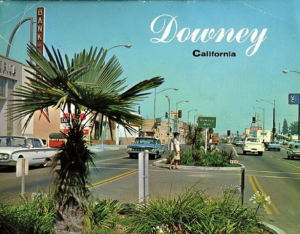
Downey Conservancy spotlights city’s special landmarks, including famous fast food hubs

George Redfox, photography teacher at Downey’s Warren High School, is accustomed to preserving moments in time with the click of a camera. But his love of local history led him to take a deeper exploration into the city’s physical structures, and create the Downey Conservancy in 2010.

“It’s exciting to walk in old houses and buildings, and think about what happened in those rooms,” said Redfox. “We recognized a few years ago that many people do not know the history behind Downey’s early structures, so we wanted to start capturing that story and educating residents.”

The community-based nonprofit organization is dedicated to promoting and supporting the preservation of the culturally and historically significant resources of the City of Downey with a special focus on its “built” structures.

Downey’s birth dates back to the late 1800’s with early Spanish settlers, and later grew into a farming community. After World War II, it took shape as a suburban neighborhood with middle-class families, many of whom worked at Rockwell International to support the aircraft and space industries.

Redfox notes Downey is quite famous for its historical fast-food presence.

In 1953, the third McDonald’s restaurant was built in Downey, and today is the oldest original McDonald’s in the country. The Johnie’s Broiler drive-in restaurant and coffee shop, which has been featured in movies and sitcoms, was built in 1958. And in 1962, the very first Taco Bell started serving the popular fast-food Mexican fare. The original Taco Bell structure was later used by a different taco company, but closed in December 2014.

Outside the restaurant scene, the Conservancy is also in the final stages of securing the city’s Molly Pitcher Estates a spot on the California Register of Historic Places. An estimated 42 Ranch-style homes, built in the 1950s, ushered in the predominance of front-facing garages with the rise of the automobile.

The Conservancy wants to ensure these early homes, designed by legendary designer Otto Hansen, are recognized for their architectural contribution, and protected for future generations.

“If all passes, the property values in that area will likely see a 20 to 40 percent increase,” said Redfox. “And we’ll make sure the original look of these homes remain intact for years to come.”

While the Conservancy is still young, Redfox notes the community is increasingly becoming aware of its presence and joining the group’s Facebook community, and also the Conservancy itself. Membership is free, but donations are encouraged.

“It’s refreshing to see our community care so deeply about preservation,” said LA County Supervisor Don Knabe. “While Los Angeles and its many surrounding cities are young compared to many parts of the country, we have some remarkable landmarks and structures. I’m thankful we have citizens documenting these pieces of history and ensuring many generations can enjoy the structures in the years ahead.”

To learn more about the Downey Conservancy, visit thedowneyconservancy.org.

Shakespeare by the Sea returns to L.A. County for a summer of outdoor theatre

Stephanie Coltrin still recalls the magical evening at Point Fermin Park in San Pedro just a few summers ago.

She was directing an outdoor performance of “King Lear,” and as if on cue, the fog rolled in at exactly the right moment.

“We had a scene where a character was describing to the king the world outside, and when that fog rolled in, it set the mood,” said Coltrin. “I got goosebumps!”

This summer, Los Angeles County residents can once again enjoy outdoor theatre, courtesy of the nonprofit organization Shakespeare by the Sea. The group kicks off their 18th season on June 18 at Point Fermin Park with “As You Like It,” and will later feature “The Tempest” on June 25 at the same location.

“I’m proud to once again support this incredible showcase that connects young teens and their families with some of the greatest literature ever written,” said Supervisor Don Knabe. “There is no better setting for a re-enactment of classic Shakespeare tales than the cliffs above the sea as the sun sets.”

Both shows will make stops at parks around the county through August, and even travel south to a few locations in Orange County.

Lisa Coffi, founder and producing artistic director for Shakespeare by the Sea, has seen the tour grow through the years. She came up with the concept as part of her Long Beach State thesis project and has hustled to gather the funds and staffing for every summer since that initial test.

“Shakespeare really was for every man,” said Coffi. “So it’s fitting our shows are offered for free to anyone who wants to enjoy an evening of theatre under the stars.”

Coffi delights in seeing the diverse audiences her shows draw during the summer months. She says on any given night, she’ll see young families, teens, elderly couples, and individuals of all ethnicities and backgrounds.

“It’s truly a communal experience,” said Coffi. “To sit in a park with hundreds of people being utterly quiet to listen to Shakespeare is quite the experience.”

Each season, a small cast is selected in the spring. They rehearse, build the set and then set out to tour in June. This year, 18 individuals will cover a total of 45 roles in the two productions. Coltrin, now an associate festival producer, will serve as director for “The Tempest.” Patrick Vest is directing “As You Like It.”

Coffi, meanwhile, will start booking shows for the following summer, and is always working to secure funds. She now resides in Northern California, but feels so passionate about Shakespeare by the Sea, she has continued to oversee and manage the productions from afar. Still, she comes down for the summers to see the fruits of her hard work. Coffi also runs Little Fish Theatre in San Pedro’s Art District.

“It’s a lot to take on, and I often feel like we are working against the grain,” said Coffi. “But we seem to make it every year, and when I come down to watch the shows, I see we really do inspire people – and many families return every summer.”

To see the complete summer schedule for Shakespeare by the Sea, visit http://www.shakespearebythesea.org. You can additionally learn how to make a donation and keep the summer performances alive in LA County via the website.

Victims of Trafficking Finally Receive Justice

Today, the House of Representatives passed, on a 420 to 3 vote, the Justice for Victims of Trafficking Act of 2015. Washington finally put aside its partisan politics and passed a bill to support the victims of child sex trafficking.  This action will provide more desperately needed resources to local governments, which are responsible for our most vulnerable children.  It will also give local authorities the ability to penalize those who buy and sell young girls, rather than punishing those who are exploited by adults for profit.  If each level of government – local, state and federal – plays its role, we can end the exploitation of innocent children and make a difference in the lives of the victims of this heinous crime.

Locally, the Los Angeles County Board of Supervisors also unanimously passed my motions to allocate $250,000 to increase training for County staff and increase advocacy for more state funding dedicated to counties to help serve the victims of child sex trafficking.  On Friday, I will lead an event with Metro officials to launch its “Don’t Be Silent” campaign, an updated trafficking awareness campaign urging metro riders to be alert to suspicious activity on buses, trains and at stations.

The War on Child Sex Trafficking Continues

Los Angeles County’s war on child sex trafficking continues this week with a slate of activities aimed at raising awareness of this heinous crime and training our staff to spot the warning signs.

At today’s Board of Supervisors meeting, I’ll put forth a motion requesting $250,000 to increase training for County staff and community partners to build awareness and better identify victims. I’ll also ask for additional advocacy to increase state funding dedicated to counties to help serve the victims of child sex trafficking.

Then on Friday, I will lead an event with Metro to launch our “Don’t Be Silent” campaign, an updated awareness campaign urging metro riders to be alert to suspicious activity on buses, trains and at stations. In addition, Metro will be training all 10,000 of their employees on what to do if they encounter a child sex trafficking victim. I am glad Metro has once again committed resources to launching a new awareness campaign, which the private sector has generously stepped up to support.

We also need our state and federal partners to not just talk about ending child exploitation, but to provide the funding we need to support the victims of this horrific crime.  It will take every segment of our community, public and private, working together to protect our most vulnerable children.